
3 Breathing Techniques Used by Navy SEALs for Focus
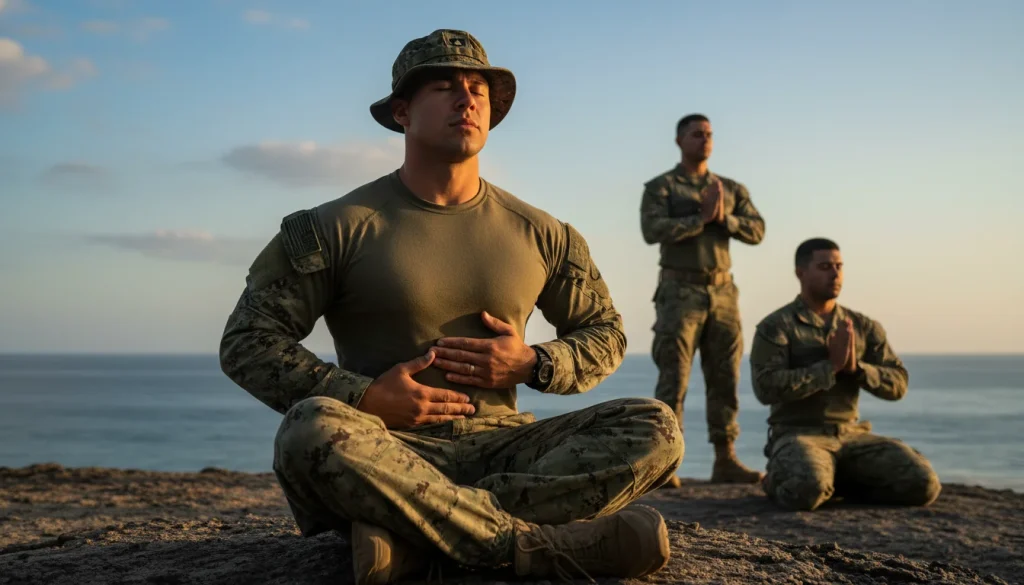
Estimated reading time: 5 minutes
The Science of Control: How SEALs Hack Their Nervous System
Navy SEALs are trained to operate in high-stakes environments where panic can be fatal. To maintain elite cognitive function under extreme stress, they utilize arousal control—specifically, breathing protocols that regulate the autonomic nervous system. By consciously altering their breath, they can switch off the “fight or flight” response (sympathetic nervous system) and activate the “rest and digest” response (parasympathetic nervous system).
The three primary breathing techniques used by special forces for focus, sleep, and endurance are:
- Box Breathing (Tactical Breathing): Used for immediate stress reduction and laser focus.
- 4-7-8 Breathing: Used for deep relaxation and rapid sleep onset.
- Rhythmic Breathing: Used to maintain oxygenation during physical exertion (running/swimming).
Below is the comprehensive breakdown of how to execute these techniques and the specific scenarios in which they are applied.
What breathing technique do navy SEALs use?
The most ubiquitous technique used by Navy SEALs is Box Breathing. Often referred to as “Tactical Breathing,” this method is taught during BUD/S (Basic Underwater Demolition/SEAL) training to help candidates regain composure during “drown-proofing” and high-stress evolutions.
How to do it:
- Inhale through your nose for a count of 4 seconds.
- Hold the air in your lungs for a count of 4 seconds.
- Exhale through your mouth (or nose) for a count of 4 seconds.
- Hold your lungs empty for a count of 4 seconds.
- Repeat for 3 to 5 minutes.
This technique is effective because the “holds” allow CO2 to build up slightly in the blood, which enhances the “Bohr Effect”—improving oxygen delivery to the brain and tissues.
What is the best breathing technique to focus?
While Box Breathing is the gold standard for calm, the best technique specifically for active focus is a variation often called Tactical Breathing (without the empty hold).
When a SEAL needs to clear the “fog of war” instantly, the goal is to lower the heart rate without causing drowsiness.
- The Method: Inhale deeply through the nose for 4 seconds, hold for 2 seconds, and exhale forcefully for 4 seconds.
- Why it works: It centers the mind on the counting process (a form of mindfulness) while physically slowing the heart rate via the vagus nerve. It bridges the gap between being too amped up to aim and too relaxed to react.
What is the 3 foot rule Navy SEALs?
The 3-Foot Rule is not a breathing technique, but a mental model often paired with breathing exercises to regain focus.
In survival situations or overwhelming combat scenarios, looking at the “big picture” can induce panic. The 3-Foot Rule dictates that you only focus on what you can control within a three-foot radius of your body.
- Application: A SEAL might use Box Breathing to lower their heart rate, then apply the 3-Foot Rule to focus solely on their immediate task (e.g., checking gear, climbing a wall, or securing a perimeter) rather than worrying about the entire mission outcome.
What is the 3 3 3 breathing technique?
The 3-3-3 technique is frequently confused with military protocols, but it is primarily a civilian anxiety grounding tool. However, it operates on similar principles of sensory interruption.
There are two variations:
- The Breath: Inhale for 3, Hold for 3, Exhale for 3. This is a faster, truncated version of Box Breathing used for mild stress.
- The Senses: Identify 3 things you can see, 3 sounds you can hear, and move 3 parts of your body.
While effective for panic attacks, SEALs generally prefer the 4-count Box Breathing method as it provides a longer duration for autonomic regulation.
Tactical breathing Navy SEALs
“Tactical Breathing” is the operational term for using breath to modulate stress responses during combat. According to Navy medical psychology protocols, Tactical Breathing is designed to keep a soldier in “Condition Yellow” (alert but calm) rather than “Condition Black” (sensory overload and panic).
Key Benefit: It prevents the loss of fine motor skills. When heart rates exceed 145 BPM due to stress, fine motor skills deteriorate. Tactical breathing brings the heart rate back down to a zone where soldiers can manipulate weapons, read maps, and communicate effectively.
Military breathing technique for running
For endurance events like rucking or long-distance running, SEALs utilize Rhythmic Breathing. This prevents “side stitches” and ensures muscles receive constant oxygenation.
The Pattern (2:2 or 3:2):
- 2:2 Cadence: Inhale for 2 foot strikes, exhale for 2 foot strikes. (Best for faster paces).
- 3:2 Cadence: Inhale for 3 foot strikes, exhale for 2 foot strikes. (Best for endurance).
By exhaling on alternating foot strikes (left then right), you distribute the impact stress across both sides of the body, reducing the risk of injury while maximizing oxygen intake.
Navy seal 4-7-8 breathing
The 4-7-8 Breathing technique is primarily used for recovery and sleep. While popularized by Dr. Andrew Weil, it is adopted by military personnel to force the body into a state of deep relaxation during short rest windows.
How to do it:
- Exhale completely through your mouth.
- Close your mouth and inhale through your nose for 4 seconds.
- Hold your breath for 7 seconds.
- Exhale completely through your mouth (making a whoosh sound) for 8 seconds.
The long exhalation is the key; it triggers a powerful parasympathetic response, acting as a natural tranquilizer for the nervous system.
Navy SEAL breathing technique sleep
Sleep is a tactical necessity. When deployed, SEALs may only have brief windows to rest. They combine the 4-7-8 technique with a method known as “progressive muscle relaxation” (often associated with the older Lloyd Bud Winter military sleep method).
The Routine:
- Perform 4 cycles of 4-7-8 breathing.
- Systematically relax the muscles in the face (jaw, tongue, eyes).
- Drop the shoulders and let arms go limp.
- Relax the legs, thighs, and calves.
- Clear the mind for 10 seconds (often visualizing a canoe on a calm lake).
Tactical breathing vs box breathing
This is a common point of confusion. Tactical Breathing and Box Breathing are effectively the same technique.
- Box Breathing: The descriptive name used in yoga and wellness circles, referring to the “four sides” of the breath (Inhale, Hold, Exhale, Hold).
- Tactical Breathing: The operational name used within law enforcement and the military. It implies the application of the technique—using the breath tactically to prepare for or recover from a threat.
If a manual refers to “Tactical Breathing,” you can assume it is the 4-count box method.
Key Takeaways
- Box Breathing (4-4-4-4) is the primary tool for immediate focus and stress management.
- The 3-Foot Rule is a mindset strategy used alongside breathing to limit overwhelm.
- 4-7-8 Breathing is utilized for rapid sleep onset and deep recovery.
- Rhythmic Breathing synchronizes breath with movement for running endurance.
- Tactical Breathing is simply the military terminology for Box Breathing.
Frequently Asked Questions
Does Box Breathing actually work?
Yes. It is scientifically proven to stimulate the vagus nerve, which reduces heart rate and blood pressure, effectively counteracting the body’s stress response.
How long should I do Box Breathing?
Navy SEALs recommend performing the cycle for at least 5 minutes to fully reset the nervous system, though benefits can be felt after just 3 to 4 cycles.
Disclaimer: This information is for educational purposes. Please consult a healthcare provider before trying new herbal remedies. Please read our full disclaimer here.